
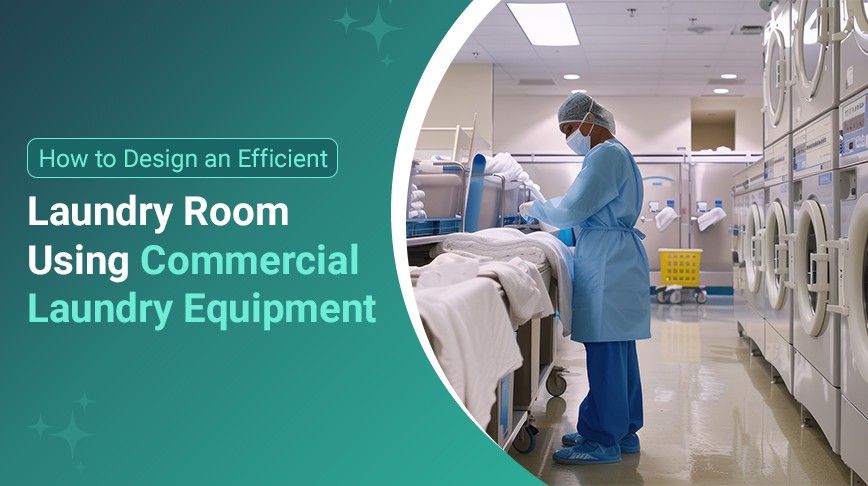
An efficient commercial laundry doesn’t start with the equipment. It starts with the room, and more specifically, with the path that dirty linen takes from the door to the shelf.
Drop brilliant machines into a badly planned space, and you’ll still get bottlenecks, extra handling, and staff walking laundry back and forth across a room that was never designed for the job. Getting commercial laundry equipment right means thinking about the whole space before choosing a single machine.
This is a walk-through of what a well-designed commercial laundry room actually needs, zone by zone.
Start With the Workflow, Not the Floor Plan
Before drawing up a layout, map the journey linen actually takes: receiving, sorting, washing, drying, finishing, folding, storage, dispatch. Every one of those steps should move in one direction. The moment laundry has to double back, you’ve built inefficiency into the room permanently.
This matters for more than speed. The European Agency for Safety and Health at Work has pointed out that well-designed workplaces reduce unnecessary manual handling and the risks that come with it, which in a laundry room translates directly into fewer injuries and less wasted staff time.
A room designed around the workflow, rather than around wherever the machines happened to fit, tends to solve both problems at once.
Choosing Commercial Laundry Equipment for Every Space
For an effective design strategy, sort your laundry room into sections and choose equipment that fit into every zone.
Zone 1: Get Receiving and Sorting Right First with a Sorting Station
This is where most efficiency gets won or lost, and it’s the zone people think about least. Dirty linen needs somewhere to land, get sorted by type, and wait briefly before washing, without piling up in a corridor or spilling into space meant for something else.
A proper sorting station needs room to separate hygiene-sensitive items from general linen, space to weigh and inspect batches before they go into a machine, and enough temporary storage that a busy morning doesn’t turn into a bottleneck at the door. Skipping this risks cross-contamination along with production delays.
Zone 2: Choose Washer Extractors for Production Goals, Not Just Capacity
Once linen is sorted, washing needs to match your actual production targets, not just look big enough on a spec sheet. That means thinking about
- load balancing across the working day,
- whether batch processing suits your volume better than continuous smaller loads, and
- how extraction speed affects everything downstream.
Some businesses do better running two mid-sized commercial washer extractors than one large one, simply because it gives more flexibility when a machine needs servicing or a load doesn’t fill a full drum. SEAI’s guidance points businesses toward washers selected on energy and water efficiency criteria specifically because these factors carry more weight over the equipment’s life than raw capacity does.
Zone 3: Industrial Dryers Designed Around Throughput, Not Just Energy Use
Drying is where a lot of laundry rooms face quiet problems. If washer output outpaces dryer capacity, laundry queues up waiting for a machine, and all that upstream efficiency gets wasted standing around.
The fix is straightforward: match dryer capacity to what your washers actually produce, not to a separate calculation done in isolation.
Moisture sensing prevents machines running longer than laundry actually needs. When combined with proper load scheduling, dryers run close to continuously rather than sitting half-empty between washer cycles. By getting the tumble dryers sized correctly, the throughput for the whole room can improve.
Zone 4: Finishing with Flatwork Ironers and Folding Stations
This is the zone competitors’ guides tend to skip. This is a mistake, because finishing is often where an operation’s actual quality shows up.
- Flatwork ironers determine how professional hotel linen or restaurant tablecloths look on delivery.
- Folding stations affect how quickly finished laundry gets from the machine to storage.
- Presentation quality shapes how guests or clients perceive the whole operation, even though it’s the last step in the process.
Flatwork ironers and folding equipment alongside washers and dryers connect these stages into one workflow rather than leaving them as disconnected purchases bolted on separately. A finishing area that’s cramped or an afterthought in the layout tends to become the slowest link in an otherwise fast system.
Build in Room to Grow
A laundry room designed for exactly today’s volume will need renovation the moment business grows even slightly. Leave space for an additional machine before you need one. Make sure utility connections can support future equipment, not just what’s installed on day one.
Keep clear access for maintenance and safe walkways for staff moving through the space. This kind of laundry room design costs a bit more up front and saves considerably more later, when adding capacity means installing a machine rather than tearing out a wall.
Treat the Layout as a Business Investment, Not a Formality
The way a laundry room is planned shapes outcomes well beyond the laundry itself. This covers turnaround times, labour costs, utility consumption, how efficiently equipment actually gets used, staff safety, and overall production capacity.
A poorly planned room can undercut genuinely good equipment, while a well-planned one gets more out of ordinary machines than you’d expect. Laundry room planning grounded in running commercial laundry facilities day-to-day tends to hold up better than planning done at a distance.
Installation, commissioning, and equipment integration all get shaped by what actually works in production, not just what looks efficient on a drawing.
A Design Checklist Worth Working Through
As best practice, you can go through the following checklist during laundry room design:
- Does the layout follow a single, linear workflow?
- Are dirty and clean zones properly separated?
- Is washer capacity matched to genuine daily volume?
- Is dryer capacity balanced against washer output?
- Is there a dedicated, adequately sized finishing area?
- Is there room built in for future equipment?
- Are utility connections sized for growth, not just current use?
- Is there proper access for servicing?
- Does the layout protect staff safety and easy movement?
- Is preventive maintenance planning built into the design?
Why The Room Comes First in Commercial Laundry Setup
A productive commercial laundry is a workflow that moves linen from dirty to clean without unnecessary handling, bottlenecks, or wasted space. Get the room right, and even solid mid-range equipment performs well. Get it wrong, and no amount of machine quality fully makes up for it.
Businesses planning a new laundry facility, or rethinking an existing one, can talk to WALE about design, equipment, and installation built on genuine operational experience rather than a standard template.
Frequently Asked Questions
What are the advantages of high-speed commercial washer extractors?
High-speed commercial washer extractors remove more moisture during the spin cycle, reducing drying time and lowering energy consumption. Faster extraction also increases daily processing capacity by allowing laundry to move more quickly through the workflow.
Which businesses benefit most from using flatwork ironers?
Flatwork ironers are ideal for hotels, restaurants, hospitals, and commercial laundries that regularly process bed linen, tablecloths, and other flat textiles. They improve presentation quality, increase finishing speed, and reduce manual ironing requirements.
How do tumble dryers affect overall laundry productivity?
Properly sized tumble dryers prevent bottlenecks by matching washer output and maintaining continuous workflow. Features such as moisture sensing and programmable drying cycles improve efficiency while protecting fabrics from unnecessary heat exposure.
Why is laundry room planning important before purchasing equipment?
Effective laundry room planning helps optimise workflow, minimise unnecessary handling, improve staff productivity, and maximise equipment performance. Planning the layout before purchasing machines reduces costly modifications and ensures every stage of the laundry process operates efficiently.