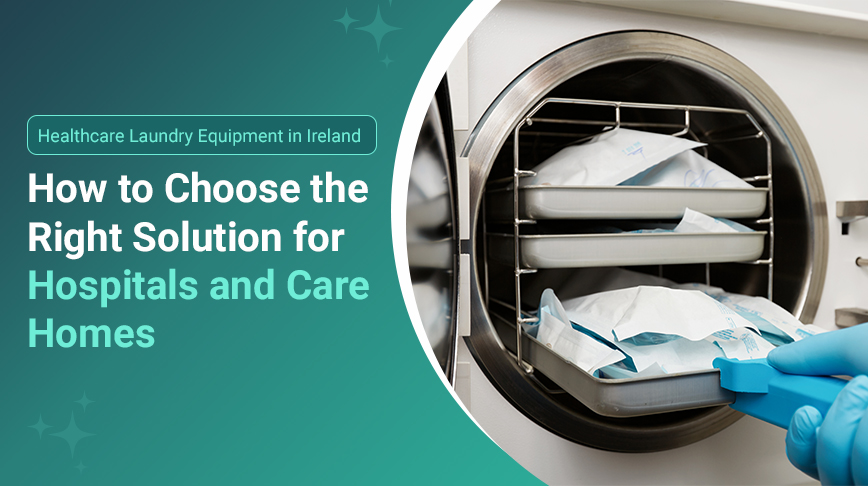
Laundry in a healthcare setting isn’t just about clean linen. It’s a direct line of defence against cross-contamination and hospital-acquired infections. Treating laundry and linens as an afterthought is how cross-contamination occurs.
Regulatory scrutiny has increased. Nursing home regulations tightened further in March 2025, with new requirements around infection prevention and control training. Facilities that still treat laundry as a routine chore rather than a compliance area are going to fall behind.
This guide covers what healthcare laundry equipment in Ireland actually needs to deliver.
Why Healthcare Laundry Is a Different Category Entirely
Standard commercial laundry equipment cleans for appearance and freshness. Healthcare laundry equipment must decontaminate, not just clean.
That distinction matters enormously in hospitals, nursing homes and residential care settings. Linen, bedding and workwear can carry pathogens capable of spreading infection between patients or residents.
Hospital laundry equipment in Ireland is increasingly assessed against this decontamination standard, not just hygiene appearance.
The Infection Control Risk Behind Healthcare Textiles
Studies on healthcare textiles consistently find that industrial laundering offers far more assurance than domestic washing. A home washing machine can’t validate or monitor wash parameters the way industrial equipment can. Home washing machines have no cycle log, no proof of temperature reached, nothing to check afterward.
That gap reflects a stark reality. Many healthcare worker uniforms in Ireland and the UK are still laundered at home. Industrial equipment closes that monitoring gap, but only if facilities actually use it for the textiles that need it.
Why Temperature and Validation Matter
Decontamination of healthcare linens typically requires laundering at high temperatures, generally 60°C or above, alongside appropriate detergents.
The temperature alone isn’t the whole story, though. Commercial healthcare laundry machines that log and validate cycle data give facilities something they can actually show an inspector; proof, not just an assurance that “we wash everything hot.” That record is steadily turning into a basic audit checkpoint during inspections, not just nice to have.
Matching Equipment to Facility Type
Different healthcare settings have different laundry demands. Equipment choice should reflect the facility’s actual patient or resident load.
Hospitals and Acute Care Settings
- High-capacity barrier washers separating clean and soiled areas
- Validated thermal disinfection cycles
- Fast turnaround for high-volume linen use
- Integration with waste and infection control protocols
Nursing Homes and Residential Care
- Mid-capacity machines suited to daily resident linen volumes
- Segregation systems for infected or soiled laundry
- Reliable servicing to avoid extended downtime
- Machines suited to smaller onsite laundry rooms
Community and Home Care Services
- Compact, reliable machines for lower-volume settings
- Straightforward operation for non-specialist staff
- Clear guidance on correct temperature settings
Compliance Signals to Look For When Choosing Equipment
Ireland’s healthcare sector operates under close regulatory watch. HIQA has been developing new national infection prevention and control standards specifically for community services, including nursing homes and home care.
There were 553 registered nursing homes in Ireland in 2023, down from 585 in 2019, reflecting a sector under sustained regulatory and operational pressure.
| Compliance Requirement | Equipment Feature That Helps |
| Validated decontamination | Thermal disinfection cycles with data logging |
| Cross-contamination prevention | Barrier or sluice-style washer configuration |
| Staff training obligations | Simple, clearly labelled controls |
| Incident traceability | Cycle records for audit purposes |
| Consistent hygiene standards | Reliable servicing and calibration support |
New nursing home regulations effective from March 2025 require infection prevention procedures to align with national guidance, along with proper staff training.
Equipment alone won’t tick every box here. But the right machines make it a lot easier to show you’re compliant during inspections.
Capacity Planning: Getting the Volume Right
Undersized equipment creates bottlenecks. Oversized equipment wastes energy and space. Getting the number right takes some upfront thinking, not just ordering whatever the last facility bought.
- Average daily linen volume per resident or patient
- Peak demand during outbreaks or high-occupancy periods
- Turnaround time needed between wash cycles
- Space available for machine footprint and airflow
- Future growth in bed numbers or resident capacity
Facilities that underestimate peak demand often find machines struggling during flu season or norovirus outbreaks, precisely when reliable laundering matters most.
Staff Safety and Workflow Considerations
Healthcare laundry means handling potentially contaminated textiles, and equipment layout should support safe handling rather than fight against it.
Barrier washers, which separate soiled loading from clean unloading, cut the risk of cross-contamination between staff areas and limit how much heavily soiled linen actually gets handled by hand.
Clear signage, colour-coded linen bags, and controls that don’t require a manual to operate all reduce the chance of mistakes when staff are working under pressure.
Common Mistakes Facilities Make When Upgrading
A handful of mistakes show up again and again in healthcare laundry upgrades. Catching them early saves a lot of expensive rework later.
- Choosing capacity based on current needs only, ignoring growth
- Overlooking servicing and validation requirements during procurement
- Selecting equipment without barrier or segregation features
- Underestimating installation requirements for plumbing and ventilation
- Failing to involve infection control staff in equipment decisions
That last one matters more than it sounds. Bringing infection prevention and control staff into the decision early, not after the machines are already ordered, tends to produce far better outcomes than treating laundry as a purely operational purchase.
Wrapping Up: Making the Right Choice for Your Facility
Healthcare laundry equipment decisions shouldn’t sit with procurement alone. Infection control, staff safety, and compliance all deserve a say.
The right equipment cuts risk, holds up under an audit, and keeps things running even when demand spikes.
For hospitals and care homes across Ireland weighing their options, WALE supplies commercial healthcare laundry machines backed by local servicing and IMESA-distributed equipment.
Frequently Asked Questions
Do care homes in Ireland need CE-marked laundry equipment?
Yes, commercial laundry equipment sold in Ireland must carry CE marking, confirming it meets EU safety standards. Always confirm this with suppliers, along with any relevant electrical and pressure equipment certifications before purchase.
What temperature is needed to kill pathogens like MRSA or C. difficile during laundering?
Most guidance recommends washing at 60°C or higher for effective thermal disinfection. Some resistant organisms may require additional disinfectant use alongside temperature, depending on facility protocols and equipment capability.
Can hospitals outsource laundry instead of buying equipment?
Yes, many hospitals use external laundry contractors for some or all linen processing. This shifts capital costs but requires strict due diligence on the contractor’s decontamination standards and compliance credentials.
How often should healthcare laundry equipment be serviced or validated?
Most manufacturers and infection control guidance recommend servicing every six to twelve months. Validated thermal disinfection equipment may need more frequent calibration checks to maintain compliance and audit readiness.