
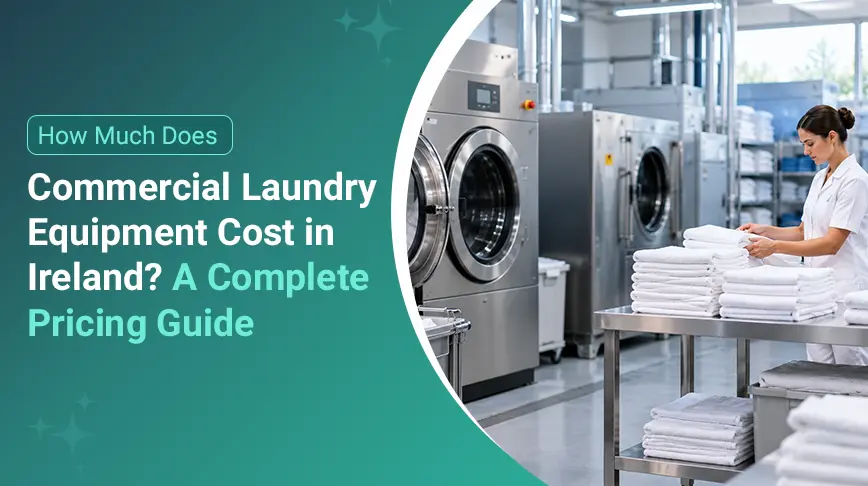
Buying commercial laundry equipment is not a decision most businesses make lightly. A washer, dryer or ironer can be a significant capital investment, particularly when you are fitting out an entire laundry room rather than replacing one machine.
The price you see on the machine is only part of the story, though. Capacity, extraction speed, heating method, installation requirements, energy consumption and expected workload can all change the real cost of running a laundry.
So, how much should you budget for commercial laundry equipment in Ireland?
There is no single figure. A small guesthouse may need a compact commercial washer and dryer, while a hotel, care home or industrial laundry may require several high-capacity machines and finishing equipment.
This guide looks at the main costs to consider before you buy, from the equipment itself to installation, infrastructure and ongoing operation.
What Affects The Cost Of Commercial Laundry Equipment?
Two machines that look similar on paper can have very different prices. The difference usually comes down to how they are built, how much laundry they can process and what the business expects them to do.
Capacity
Capacity is one of the biggest influences on price.
A compact commercial washer designed for an 8 kg to 12 kg load will cost considerably less than a 40 kg, 60 kg or larger industrial washer. The same principle applies to tumble dryers and other equipment.
The important question is not simply how much laundry you process on an average day. You also need to consider your busiest periods.
A hotel, for example, may have a manageable daily laundry volume in the quieter months but significantly higher linen volumes during peak season. Buying equipment around the average rather than the actual workload can create bottlenecks later.
Machine construction
Commercial laundry equipment is built for substantially heavier use than domestic appliances.
The construction and mounting system also affect the installation requirements. Some machines are designed to be rigidly mounted, while high-speed washer extractors can use suspension systems to manage the forces generated during extraction.
That matters when planning the laundry room, particularly if equipment is being installed on an upper floor.
Heating method
Electric, gas and steam-heated equipment can have different purchase and running costs.
An electric machine may have a lower initial cost in some configurations, while gas or steam options can make more sense for businesses processing large volumes. The right choice depends on the building, available services, laundry volume and local energy costs.
This is why comparing machines purely on their purchase price can give you the wrong answer.
New, refurbished or ex-demonstration equipment
Buying refurbished or ex-demonstration equipment can reduce the initial investment.
However, the savings need to be weighed against the machine’s age, condition, warranty, availability of spare parts and expected remaining service life.
For a business that depends on laundry every day, a cheaper machine is not necessarily cheaper if it requires frequent repairs or cannot keep up with demand.
Installation requirements
The equipment itself is only one part of the project.
Depending on the machine, you may need changes to electrical supplies, plumbing, drainage, ventilation, gas connections or flooring. Large commercial installations may also require changes to the layout and workflow of the laundry room.
These costs should be established before the equipment is ordered, rather than discovered when it arrives.
How Much Do Commercial Washing Machines And Dryers Cost?
Prices vary significantly by manufacturer, capacity and specification, so it is more useful to think in broad equipment categories than one fixed figure.
At the smaller end of the commercial market, Irish suppliers currently list professional washing machines and dryers in the low thousands of euros. For example, current listings include commercial machines around the €2,000 to €5,000 range, depending on capacity and specification.
Larger commercial and industrial machines move considerably higher. IMESA, for example, produces washer extractors across capacities ranging from approximately 8 kg to 125 kg, while its commercial dryer range extends from around 11 kg to 75 kg.
As a broad planning guide, businesses may encounter the following indicative ranges:
| Equipment | Indicative budget |
| Small commercial washer | €1,500–€4,000+ |
| Medium commercial washer extractor | €4,000–€10,000+ |
| Larger industrial washer extractor | €10,000–€30,000+ |
| Commercial tumble dryer | €2,000–€7,000+ |
| Larger industrial dryer | €5,000–€12,000+ |
| Commercial flatwork ironer | €3,000–€12,000+ |
These are planning figures rather than fixed prices. The final quotation depends on capacity, configuration, heating source, controls, installation and other site requirements.
Current Irish listings illustrate just how wide the market can be. Commercial dryers range from smaller professional models at around €1,600 to €2,500 through to larger IMESA machines priced at more than €4,000 to €6,000 before VAT, depending on capacity and configuration.
Don’t Forget The Finishing Equipment
Washing and drying are only two parts of a commercial laundry.
Hotels, healthcare facilities and businesses handling large quantities of flat linen may also need equipment such as flatwork ironers and folding machines. A small rotary ironer can be suitable for lower-volume operations, while larger ironers are designed to process considerably more linen at a time.
The right finishing equipment can make a substantial difference to labour requirements and turnaround times. It is therefore worth considering it as part of the original laundry design rather than adding it later.
What Additional Costs Should You Budget For?
The equipment quotation is rarely the complete project cost.
Delivery and installation
Large commercial machines require appropriate delivery and professional installation. Access to the premises can also affect the cost.
Before purchasing, establish whether the quotation includes delivery, positioning, commissioning and staff training, or whether these are charged separately.
Plumbing and drainage
Commercial washers can require higher water flow and suitable drainage arrangements than domestic appliances.
If the existing plumbing is not suitable, you may need additional work before the machine can be installed.
Electrical supply
Some commercial laundry equipment requires three-phase electrical power. Upgrading the electrical supply can therefore become a significant part of the installation budget.
This is something to establish during the site survey, not after the equipment has been delivered.
Ventilation and extraction
Vented dryers need suitable exhaust arrangements. The ducting route, external termination and ventilation requirements should all be considered during the design stage.
A compact machine may be relatively straightforward to install. A larger laundry with several dryers requires much more careful planning.
Detergent dosing
Automatic chemical dosing systems can improve consistency and reduce the amount of manual handling involved in laundry operations.
Depending on the supplier and chemical agreement, dosing equipment may be purchased separately or included as part of a wider chemical supply arrangement.
Buying versus leasing commercial laundry equipment
Once you know what equipment you need, there is another question to answer: how are you going to pay for it?
Outright purchase
Buying equipment outright requires more capital at the beginning, but the business owns the machines immediately. For established operations with available capital, this can make sense where the equipment is expected to remain in service for many years.
Your accountant can also advise on the tax treatment and capital allowances applicable to your business.
Equipment leasing
Leasing spreads the cost over an agreed period rather than requiring the full purchase price upfront. This can make budgeting easier for businesses that want to preserve working capital. The total cost will depend on the equipment, lease term, interest and agreement structure.
Do not compare leasing and buying solely by looking at the monthly payment. Look at the total amount payable over the full term.
Why Is the Purchase Price Not the Real Cost
This is probably the most important point when comparing commercial laundry equipment. A machine that costs less to buy may use more water or energy. It may also have a lower extraction speed, increasing the amount of moisture left in the linen before drying.
A higher-spin washer extractor can remove more water during the wash cycle, which can reduce the work required from the dryer. Similarly, more efficient dryers can have a higher purchase price but lower energy requirements.
The calculation should therefore include:
- Purchase price
- Installation
- Energy consumption
- Water consumption
- Detergent use
- Maintenance
- Expected service life
- Downtime and repair costs
- Labour requirements
- Resale or replacement value
This is your total cost of ownership. It is often a much more useful number than the price on the quotation.
How to Get Better Value From Your Equipment Investment
You do not necessarily need the biggest or most expensive machine. You need equipment that matches the way your business actually operates.
Start with your laundry volume and identify your busiest days. Then consider how quickly the laundry needs to move from washing to drying to finishing.
It is also worth getting several quotations based on comparable specifications. Make sure you are comparing like for like, including capacity, heating method, extraction speed, warranty, installation and aftercare.
And ask about servicing before you buy.
Commercial laundry equipment is expected to work hard. Access to spare parts, technical support and regular servicing can matter just as much as the initial specification.
Wrapping Up: Get the equipment right before you buy
Commercial laundry equipment in Ireland can range from a few thousand euros for smaller professional machines to tens of thousands for larger industrial equipment and complete laundry installations. The right budget depends on your laundry volume, available space, business sector and expected growth.
A guesthouse does not need the same laundry setup as a 200-room hotel. A care home has different requirements again, while an industrial laundry may need a completely different combination of washers, dryers and finishing equipment. The best starting point is therefore not a machine catalogue. It is understanding what your laundry needs to achieve every day.
WALE works with businesses across Ireland to select, install and support commercial laundry equipment, from individual machines to complete laundry solutions. As the official Irish agent for IMESA, we can help businesses assess their requirements and choose equipment suited to their operation.
Frequently Asked Questions
What additional installation costs should I budget for?
Installation costs depend on the premises and equipment. Allow for possible electrical, plumbing, drainage, ventilation and delivery work. A site survey can identify these requirements before you commit to the purchase.
Can I use domestic washing machines in a commercial business?
Domestic machines are generally not designed for the workload associated with commercial laundry operations. Commercial equipment is built for heavier use, higher throughput and more demanding operating conditions.
Are refurbished commercial laundry machines worth considering?
Refurbished or ex-demonstration equipment can reduce the initial purchase price. Check the machine’s condition, service history, warranty, spare-parts availability and expected remaining lifespan before buying.
What is the most important factor when choosing commercial laundry equipment?
Capacity should match your actual workload, including peak periods. Energy use, extraction speed, installation requirements, service support and expected lifespan should then be considered alongside the purchase price.