
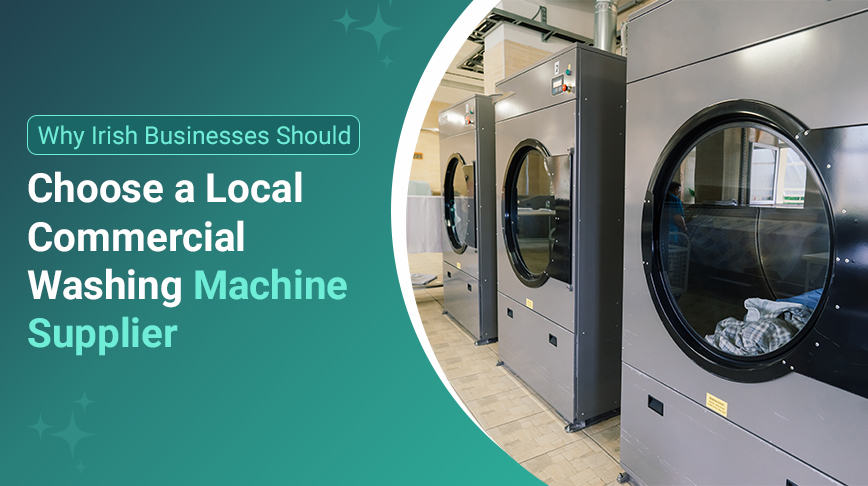
Sourcing equipment from overseas often looks like the cheaper option at first glance. Lower sticker prices and a wider brand selection make it tempting, especially when you’re comparing quotes side by side, and the overseas number just looks smaller.
That calculation rarely accounts for shipping delays, import costs, or what happens when a machine breaks down months later, and the nearest engineer is a flight away. Local support tends to matter more than most buyers expect going in, and it usually only becomes obvious once something has already gone wrong.
This guide explains why choosing a local commercial washing machine supplier often works out better for Irish businesses, once you factor in the full picture rather than just the purchase price.
What “Local” Means for a Commercial Washing Machine Supplier
A local supplier isn’t just a company that happens to be registered in Ireland on paper. That distinction matters, because plenty of businesses list an Irish address while the actual servicing and stock sit somewhere else entirely. Being local means engineers who can reach your site quickly when something fails, and stock held close enough to matter when a part needs replacing today, not in three weeks.
Industrial washing machines in Ireland sourced through a local distributor typically come with clearer warranty terms and faster support than equipment bought directly from an overseas manufacturer. The paperwork alone tends to be simpler, since no language barrier or time zone gap is slowing down a warranty claim.
That distinction becomes important the moment something goes wrong, which for commercial laundry equipment is a question of when, not if.
The Hidden Costs of Buying From Overseas
Overseas pricing rarely tells the full story. Duties, VAT, and shipping costs can add considerably to the final bill, often enough to erase whatever saving looked appealing on the initial quote.
Import duty rates into Ireland range from 0% to 12% or more, depending on the commodity code, plus standard VAT at 23% on top. Broker fees and customs handling can add further costs on top of that, and those fees rarely appear on the original price sheet.
| Cost Element | Local Supplier | Overseas Supplier |
| Shipping and freight | Minimal or none | Often significant |
| Import duties and VAT | Not applicable | 0 to 12% duty plus 23% VAT |
| Lead time | Typically days to weeks | Often weeks to months |
| Currency risk | None | Possible, depending on origin |
| Customs delays | Not a factor | A common risk |
These costs often close the gap between an overseas quote and a local one, and sometimes they reverse it entirely once everything is added up. What looked like a bargain on paper can end up costing more once the machine actually arrives and gets installed.
Faster Response Times When Something Breaks
A machine breakdown is disruptive under any circumstances, but it becomes far worse when the nearest engineer is several time zones away and doesn’t start their day until yours has already ended.
Local commercial laundry equipment suppliers in Ireland can typically respond to breakdowns within a day or two. Overseas suppliers often can’t match that, particularly for parts requiring international shipping, where a single missing component can stall the whole repair for weeks.
For hotels, care homes, and hospitals running daily laundry operations, that difference in response time carries real operational weight. A day or two of downtime is manageable. A month is a different problem entirely, one that affects staff, guests, and residents alike.
A Changing Sourcing Landscape Since Brexit
Brexit has already reshaped how many Irish businesses source equipment, and the shift shows up clearly in the data. Around 61% of Irish SMEs have reduced or completely stopped using British suppliers since the changes took effect.
The same survey found 48% of Irish SMEs cited transport and energy costs among their biggest business risks. Local sourcing directly reduces exposure to both of those pressures at once, rather than just one or the other.
Nineteen per cent of Irish SMEs have shifted towards EU-based suppliers since Brexit, which reflects a broader move towards sourcing closer to home rather than a one-off reaction to a single policy change.
Understanding Irish Standards, Grants and Regulations
Working with an Irish commercial laundry equipment supplier offers practical advantages that go beyond shorter delivery times. Local providers are already familiar with national compliance requirements, including applicable safety regulations, certification standards, and evolving energy-efficiency policies. This reduces the risk of specification errors and simplifies the purchasing process.
The Sustainable Energy Authority of Ireland (SEAI) has approved more than €175 million in funding for over 13,000 Irish businesses during the past three years to support energy-efficiency projects.
Suppliers that regularly serve the Irish market are often better placed to identify whether a planned equipment upgrade may qualify for available grants or incentives. While they cannot guarantee funding, their familiarity with current schemes can help businesses make more informed investment decisions and maximise the value of capital expenditure.
Supporting Local Supply Chains and Resilience
Choosing a local commercial laundry equipment supplier in Ireland also supports the wider domestic supply chain, and that resilience matters more than it once did, particularly after a few years of visible global shipping disruption.
- Reduces exposure to international shipping disruptions
- Keeps servicing and spare parts within reach
- Supports Irish jobs across sales, servicing, and logistics
- Builds a long-term relationship rather than a one-off transaction
Businesses whose own suppliers fail can face serious knock-on effects, sometimes well beyond the original problem. Choosing partners closer to home reduces that chain of risk, since fewer links in the supply chain could break at once.
When Local Isn’t the Only Consideration
Local sourcing isn’t automatically the right answer for every purchase, and it’s worth being honest about that. Highly specialised equipment sometimes only comes from a specific overseas manufacturer, and no amount of local preference changes that reality.
In those cases, working with a local distributor for that brand offers a solid middle ground. You get manufacturer-grade equipment with local servicing and support attached, which covers most of what makes local sourcing appealing in the first place, even when the machine itself was built somewhere else.
Making the Decision That Fits Your Business
Price alone rarely tells the full story when comparing suppliers. Lead times, servicing, and hidden import costs all affect the real value of a purchase, often more than the number on the initial quote suggests.
For most Irish businesses, a local commercial washing machine supplier offers a stronger balance of cost, reliability, and support over the equipment’s lifetime, even when the upfront price looks slightly higher than an overseas alternative.
For hotels, hospitals, and care homes across Ireland weighing up their options, WALE supplies commercial laundry equipment backed by local servicing and IMESA-distributed machinery.
Frequently Asked Questions
Are local suppliers more expensive than importing equipment directly?
Not necessarily. Once shipping, duties and VAT are added to overseas quotes, local suppliers often work out similarly priced or cheaper, especially when servicing costs are factored in.
Do local suppliers offer the same range as international manufacturers?
Many local suppliers distribute recognised international brands, offering similar product ranges to buying directly overseas. This gives businesses manufacturer-grade equipment with local support included.
What happens to warranty support if I buy from an overseas supplier?
Warranty claims can involve longer wait times, international shipping for parts, and less straightforward communication. Local suppliers typically handle warranty issues faster and with less hassle.
Can a local supplier still provide internationally recognised brands?
Yes, many Irish suppliers are official distributors for established international manufacturers. This means businesses get recognised brand quality alongside local servicing and support.