
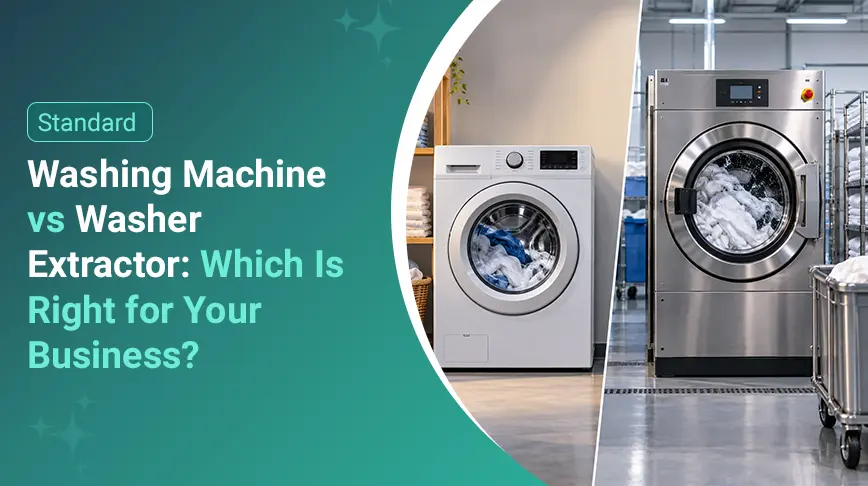
When your business handles a steady stream of laundry, choosing the right machine is about more than getting clothes, towels or linens clean. The equipment you select can affect drying time, energy consumption, labour requirements and the amount of laundry you can process in a working day.
For smaller operations, a standard commercial washing machine may provide the capacity and functionality required. Businesses handling larger or more demanding loads, however, may benefit from the higher extraction performance and programmable operation of a washer-extractor.
Understanding the differences between the two can make it easier to match your equipment to your laundry volume, available space, budget and long-term operating requirements.
What Is a Standard Commercial Washing Machine?
A standard commercial washing machine is a more robust version of the type of washer commonly used in homes. It is built with commercial-grade components and is designed to handle heavier, more frequent use than a domestic appliance.
These machines are available in front-load and top-load configurations and are generally suited to light commercial applications. Typical characteristics include:
- Load capacities of around 15 to 30 lbs.
- Spin speeds of approximately 100 to 200 G-force.
- Straightforward electrical and plumbing connections.
- Suitability for businesses with moderate daily laundry requirements, such as salons, gyms, B&Bs and coin laundromats.
The main limitation is extraction performance. Because standard commercial washers remove less water during the spin cycle, laundry can enter the dryer with relatively higher moisture content. This extends drying times and increase energy use.
What Is a Washer-Extractor?
A washer-extractor combines washing and high-speed water extraction in one commercial laundry machine. It is designed for operations that need to process larger volumes efficiently and remove more moisture before laundry reaches the dryer.
Depending on the model, washer-extractors can offer considerably greater capacity and extraction force. Common characteristics include:
- Capacities ranging from around 30 lbs to more than 400 lbs.
- Spin speeds of approximately 300 to 450+ G-force.
- Hard-mount models that are bolted to reinforced concrete foundations.
- Soft-mount models with built-in suspension that can accommodate a wider range of installation environments.
- Suitability for commercial laundry facilities, large hotels, hospitals, correctional facilities and businesses processing high volumes of linens or sportswear.
The key difference is extraction. Higher spin speeds remove more water mechanically before drying begins. In a high-volume laundry operation, that can mean shorter dryer cycles and lower utility consumption.
Standard Washing Machine vs Washer-Extractor: Key Differences
The table below summarises the main differences to consider when comparing the two types of commercial laundry equipment.
| Feature | Standard Commercial Washing Machine | Heavy-Duty Washer-Extractor |
| Primary target | Light-duty commercial / lower volume | Heavy-duty commercial / high volume |
| Load capacity | 8kg – 150kg | 8kg – 150kg |
| Moisture retention | Higher, approximately 50-65% | Lower, approximately 35-45% |
| Drying time | Longer | Shorter |
| Controls | Preset cycles | Programmable microprocessor controls |
| Initial investment | Lower | Higher |
| Long-term ROI | More limited where volumes are high | Potentially stronger where extraction and throughput reduce operating costs |
Core Criteria to Evaluate for Your Business
Before choosing a machine, consider how your laundry operation actually works. The following factors can help you assess whether a standard commercial washing machine or a washer-extractor is the better operational fit.
1. Water Extraction and Drying Efficiency
The amount of moisture left in laundry after washing has a direct bearing on drying efficiency. The source material indicates that standard commercial washers can leave fabrics with roughly 50-65% moisture, compared with approximately 35-45% for a high-spin washer-extractor.
That difference matters because mechanical extraction generally requires less energy than removing the same water through heat and evaporation. A lower moisture level can therefore provide several operational benefits:
- Faster drying, with the source material indicating potential reductions of around 20–30 minutes per load.
- Lower gas or electricity use because dryers run for less time.
- Less exposure to high heat, which can help towels and linens retain their condition over time.
2. Throughput, Volume and Cycle Speed
If your business processes hundreds or thousands of pounds of laundry each day, every minute of cycle time can affect overall throughput. Washer-extractors are designed for this kind of high-volume environment.
The source material notes that features such as programmed water valves, wider 3-inch drain valves and rapid chemical injection can help washer-extractors complete a full wash cycle in around 30–45 minutes. Standard washers may take around 50–65 minutes for a comparable job.
3. Programmability and Chemical Control
Programmability becomes particularly useful when different types of laundry require different wash processes. Many washer-extractors use microprocessor controls to manage water levels, temperature, cycle duration and chemical injection across multiple channels.
This level of control can be particularly relevant for:
- Healthcare facilities with specific sanitisation requirements.
- Hotels and restaurants washing table linens and other fabrics with consistent process requirements.
- Gyms and sports facilities handling a mixture of synthetic sportswear and heavier cotton towels.
Standard washers generally rely on preset programmes such as Normal, Heavy Duty or Delicates, which may provide less control over temperature, water levels and chemical dosing.
Hard-Mount vs. Soft-Mount Washer-Extractors
If a washer-extractor is the right fit for your operation, installation requirements are another important consideration. Hard-mount and soft-mount machines differ mainly in how they manage the forces generated during high-speed extraction.
Hard-Mount Washer-Extractors
Hard-mount machines use a rigid frame and do not have built-in shock absorption. They therefore need a suitable foundation capable of handling the forces generated during extraction.
- Typically bolted to a reinforced concrete slab, with the source material specifying a foundation around 6-8 inches thick.
- Generally lower in upfront cost than soft-mount alternatives.
- Well suited to ground-floor laundry rooms with a solid concrete foundation.
Soft-Mount Washer-Extractors
Soft-mount machines use built-in springs and shock absorbers to manage vibration and extraction forces. This makes installation more flexible where a specialist foundation is not practical.
- Do not require the same dedicated foundation as hard-mount machines.
- Can be installed on suitable ground-floor concrete, upper-floor wood-framed buildings or elevated slabs, subject to site requirements.
- Can achieve high extraction forces.
Which Option Between Washing Machines and Washer Extractor Fits Your Business?
There is no single machine type that suits every business. The right choice depends on the volume of laundry you process, how frequently the equipment runs, your available installation space and the importance of drying speed and operating costs.
A standard commercial washing machine may be appropriate when:
- Laundry volumes are relatively low or moderate.
- Loads are processed throughout the day without the need for maximum throughput.
- A lower initial investment is an important consideration.
- The operation can accommodate longer drying times.
A washer-extractor may be more appropriate when:
- The business handles consistently high laundry volumes.
- Reducing dryer time and utility consumption is a priority.
- The operation needs programmable wash and chemical controls.
- Higher throughput and extraction performance are important to day-to-day productivity.
The initial purchase price should therefore be considered alongside ongoing operating costs. For a high-volume laundry, faster extraction can influence dryer usage, labour time and the overall amount of laundry that can be processed within a working day.
Wrapping Up
Choosing between a standard commercial washing machine and a washer-extractor ultimately comes down to the demands of your laundry operation. Standard machines can meet the needs of smaller businesses with moderate volumes, while washer-extractors are designed to support larger workloads, stronger extraction and greater control.
Consider capacity, G-force, drying requirements, cycle times, programmability, installation conditions and long-term operating costs before making a decision. Looking at the complete cost of running the equipment, rather than only the initial purchase price, can give you a clearer picture of which solution fits your business.
If you are assessing commercial laundry equipment for your operation, WALE can help you explore suitable options based on your requirements.
Frequently Asked Questions
What exactly is G-force in a washer-extractor?
G-force describes the force applied to laundry during the spin cycle relative to gravity. Higher G-force generally means more water can be removed mechanically, reducing the moisture that needs to be removed during drying.
Can a washer-extractor reduce laundry operating costs?
It can. By removing more water before the drying stage, a washer-extractor can shorten dryer cycles and reduce the energy needed for evaporation. It can also support higher throughput, although actual savings depend on usage and operating conditions.
Does a washer-extractor need special utility connections?
The source material indicates that washer-extractors typically require three-phase power, larger water lines of around 2 to 2.5 cm, and a 7.6-cm gravity drain. Exact requirements depend on the machine and installation.
Should I choose a hard-mount or soft-mount washer-extractor?
The choice depends largely on the installation site. Hard-mount machines require a suitable reinforced concrete foundation, while soft-mount models have built-in suspension and can offer greater installation flexibility where site conditions allow.