
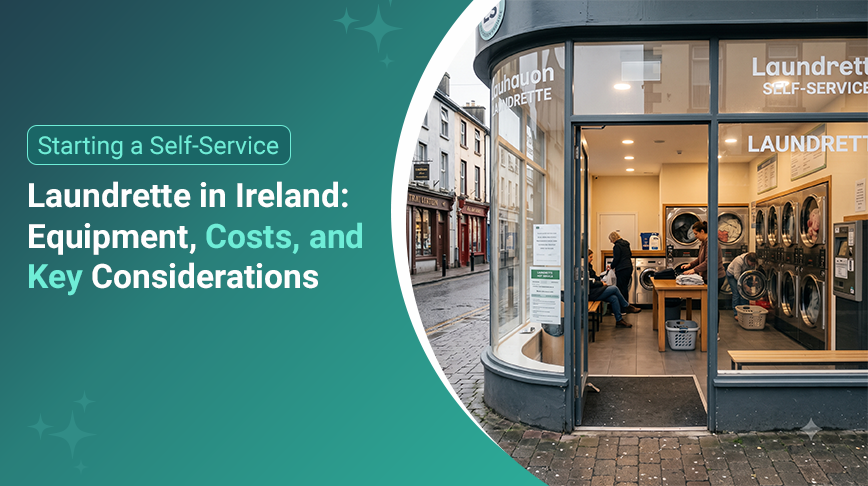
Commencing a self-service laundrette business seems fairly straightforward from the outside. All you need is to find a place for your business, purchase several washing and drying machines, organise payment facilities, and leave everything to your customers. The fact is that a lot of things are involved in it.
Your machines must stand the stress of constant working all day long. The arrangement of the premises must be reasonable. You have to provide enough utilities for the machines to function. Your drying capacity must equal your washing capacity. And you have to make the numbers right after calculating all the costs of renting the premises, purchasing the equipment, and organising utilities.
Your business might become a very costly affair if you miss any one of these aspects. It would be best to think about your ideal laundrette business first and after that about the equipment and premises.
Consider Your Location and Customer First
As you consider your laundrette equipment in Ireland, keep in mind the kind of customers you will serve. Your customer base is probably quite different whether you’re opening a laundrette in an urban centre compared to a location next to student accommodation.
Consider:
- How many customers can you realistically attract within your vicinity?
- Are there many rental properties within your location?
- Is there any student accommodation within your vicinity?
- Do residents have limited access to laundry facilities?
- What kind of hours will your customers expect from you?
- How much competition do you already have?
Think about the load type that the customers are likely to bring into the laundry. The majority will be the usual clothing and linen. On the other hand, the larger machines can help you attract customers who want to wash duvets, blankets, and towels and similar bulky items.
Get the Washer and Dryer Mix Appropriate
In this case, the equipment decision becomes crucial. However, there is no need to install ten similar washing machines just because the available space can accommodate them. There should be a balanced variety of capacities that will provide the customers with various choices without leaving costly equipment half-filled.
Small capacity machines are sufficient for regular loads, whereas machines with larger capacities may come in handy when dealing with bulk laundry. The same rule goes for the dryers. When customers manage to wash their laundry swiftly, but have to wait twenty minutes to get the dryer, you get yourself into trouble. There has to be a balance between washing and drying capacity.
Commercial washer extractors are ideally designed for the environment, where machines are supposed to do many cycles throughout the day. Similarly, commercial tumble dryers should also have enough capacity to meet the customers’ demand. It all depends on the size of your place and anticipated usage, among other things.
Never Purchase Based on the Machine Price
Price is an obvious number. It is not the only number you should consider. A machine that is cost-effective initially but uses more water and takes longer to complete a cycle can become considerably more costly after a certain time. When considering laundrette machinery, you should pay attention to the total cost of ownership and consider the following factors:
- Water usage
- Energy consumption
- Cycle time
- Machine capacity
- Maintenance
- Availability of spare parts
- Expected machine usage frequency
In a self-service laundrette, machines run constantly, and small savings in operating expenses can become huge savings when multiplied by hundreds or thousands of runs. The least expensive machine to purchase is not always the best for operation.
Premises Need To Take Up The Role of a Laundry
The premises can seem perfect on paper and yet be entirely unsuitable for a laundrette. One needs adequate space for movement, but there are other factors that need to be considered as well. The factors are water supply, drainage, electrical requirements, ventilation, heating, and access for maintenance and installation.
And then, of course, there is the workflow itself. The customer needs to operate the machines, move between wash and dry rooms, and take the clothes out without the place becoming overcrowded. The maintenance personnel, too, need reasonable access to the equipment.
Machines that were positioned close to walls may have seemed fine on the first day of operation. However, it will become a different matter when servicing is required. This is one reason why it is a good idea to plan the laundrette room before deciding on the actual equipment configuration.
Consider Drying Capacity from the Start
In some instances, dryers have been seen as the second half of the equation in a laundrette. This should not be the case. Clients expect to wash and dry their clothes without unnecessary time spent waiting around. This means that if you do not have adequate drying capacity to match the number of washing machines you have, your overall operation slows down.
It is thus important to consider the capacity of dryers, along with their cycle time and power usage, when you purchase a washing machine. You should also consider the kind of dryer installation that will fit in with your facility and utility requirements.
Ease of Payment and Payment Methods are Key
Self-service clients do not want to waste their time figuring out how to use intricate machines. It is necessary to ensure that the machinery is user-friendly and that there are clear directions and a simple payment system.
Cashless, card or some other payment methods may be considered depending on your business model and who you aim at. The more convenient it is for customers, the better. Customers should be able to come in, figure out what needs to be done, make payment, activate the machine, and leave.
Never Ignore Maintenance
A laundrette needs to use all its machines. Not having any one of them works against you. Not having several of them will have a direct impact on your bottom line. It means that the servicing and parts of the machines play an important role in the buying process. Asking questions like this when you’re choosing a commercial laundry equipment supplier in Ireland is critical.
- Who will service the machines?
- What about parts supply?
- How quick is it?
- Will installation be included in the deal?
- Do they offer technical support after the sale?
This is because the cost of running your business does not stop if the machines break down. While it does not generate income, you still need to pay your bills.
Final Thoughts
Setting up a self-service laundrette in Ireland is not about merely populating a room with washing and dryer machines. Location, client base, machinery, drying capability, utilities, design, payments, running costs and after-sales support must fit together seamlessly. Design your business before deciding on machinery. Choose machinery that can cope with your business volume, minimise running costs and allow for growth.
For businesses considering establishing a new laundrette or upgrading their existing facilities, WALE can offer assistance. Whether it is equipment selection, laundry room design, installation, start-up, service, or maintenance, the company provides you with proper assistance. With actual experience of running such a business and nationwide coverage throughout Ireland, the company can assist you with designing your self-service laundrette according to your needs.
Frequently Asked Questions
What equipment is required to start a self-service laundrette?
Commercial washing machines and tumble dryers are most likely required. The correct combination of machines and other equipment needed will depend on the premises and demand for your services.
How much does it cost to start a laundrette in Ireland?
There is no set cost associated with the startup. The cost depends on a number of parameters, and it is better to estimate the total cost than just the machines’ price.
Which washing machine sizes should I buy for my self-service laundrette?
The right thing is not to choose only one size but to combine them. Smaller machines are for daily washing and bigger machines are for washing duvets and blankets.
How many dryers do I need for my laundrette?
The number of drying machines depends on the number of washing machines and the size of the laundrette itself. It is good to consider the whole process.